Stay Connected

AIIKS Global Hub

Transforming Knowledge Systems

About Us

Learn about our mission, vision, and commitment to preserving and promoting African indigenous knowledge systems.

Background

The AIIKS was founded as part of rectifying the social and epistemic injustices created by Africa's history of slavery, colonialism and other forms of imperialism, which marginalized African indigenous cultures and associated indigenous knowledge systems and languages in the global knowledge economy.

The continent is the only region in the world where formal education, socio economic development strategies, research and human capital development efforts are promoted through foreign ideologies, languages, and knowledge production methodologies. Africa is also the only continent where countries are categorized according to their European colonial masters' languages, i.e. Francophone Africa, Anglophone Africa and Lusophone Africa.

However, ongoing impacts to global challenges have continuously shown that western knowledge systems do not have all the solutions. The majority of the local communities in developing regions including Africa, depend on their local/traditional/indigenous/community-based knowledge, technology and value systems for sustainable livelihood, which need to be recognized in the global pool of knowledge systems.

Therefore, there is need for complementarity and democracy of knowledge systems, including IKS in the global knowledge economy as part of advancing social and epistemic justice. Moreover, there is need for a regional, continental and international platform to coordinate and promote the history of African indigenous science, technology and innovation embedded African indigenous languages and home-grown philosophies for the Africa we want (AU Agenda 2063) and contribute to the attainment of the UN Sustainable Development Goals (SDGs).
Hub and Nodes Model

The Institute is based on the Hub and Nodes model. The AIIKS has its Hub at the DSI-NRF Centre of Excellence in Indigenous Knowledge Systems (CIKS), at the University of KwaZulu-Natal (UKZN), South Africa. The CIKS is a Centre of Excellence (CoE) funded by the Department of Science and Innovation (DSI) through the National Research Foundation (NRF) in South Africa. The CoE consortium consists of five (5) higher education institutions in South Africa, namely University of KwaZulu-Natal (CIKS hub), North West University (NWU), University of South Africa (UNISA), University of Limpopo (UL) and University of Venda (UNIVEN). The AIIKS Nodes include the following Higher Education and Autonomous Research Institutions within and outside the African continent. The majority of the AIIKS member institutions are located in least developed countries in Africa.

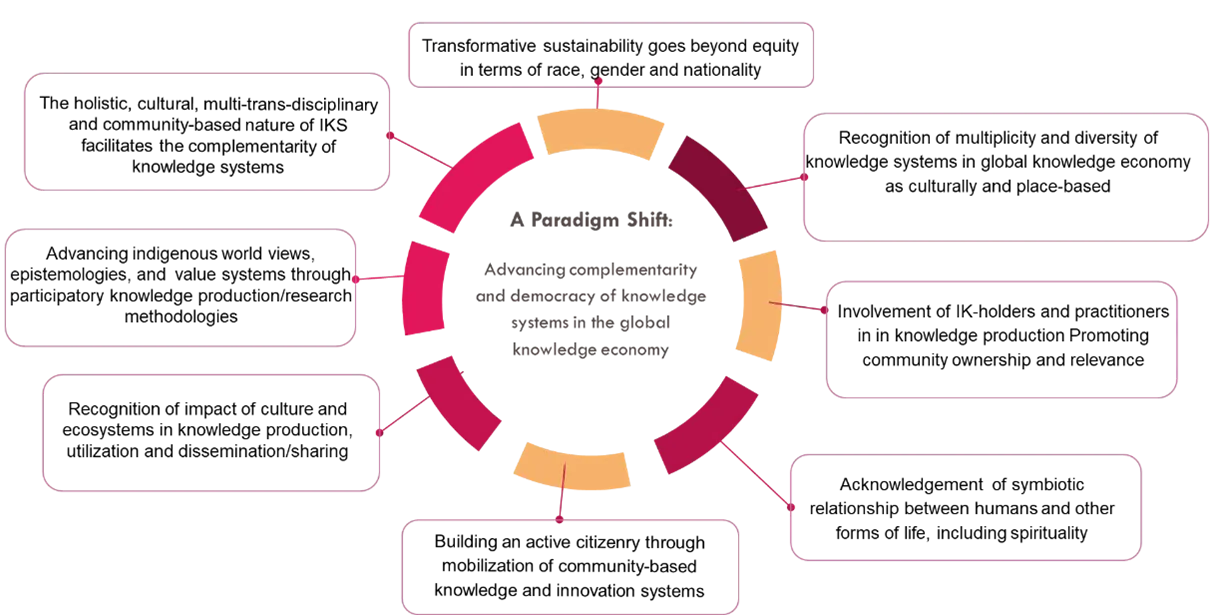
AIIKS Paradigm Shift

Advancing Complementarity and Democracy of Knowledge Systems in the global Knowledge Economy

AIIKS Paradigm Shift

Vision

An African Indigenous Knowledge Hub for the Advancement of African Scholarship and Restoration of African Dignity.

Mission

To promote and support the contribution of African Indigenous Knowledge Systems to the global pool of knowledge.

Our Objectives

  1. To establish a continental Institute on Indigenous Knowledge Systems in Africa, building on the already existing national, regional and continental IKS instruments and imperatives;
  2. To maintain recognition as a UNESCO Category II Centre;
  3. To use the holistic, multi-and trans disciplinary, community and cultural, ecological specific-based nature of African Indigenous Knowledge Systems (AIKS) including indigenous languages and home-grown philosophies, to decolonize and transform research, innovation and knowledge production/scholarship in Africa;
  4. To build a critical mass of continental IKS multi-and trans-disciplinary human capital, conversant with Indigenous Knowledge (IK) worldviews, ways of knowing, value systems and research methodologies, for promoting research, innovation and knowledge creation in identified strategic areas for Africa's sustainable development;
  5. To promote the use of African indigenous languages for communicating African home-grown philosophies in the domestication and localization of UN Sustainable Development Goals (SDGs) in Africa;
  6. To contribute to the implementation of the African Union (AU) Agenda 2063 (The Africa We Want), through the systematization of African Indigenous Knowledge Systems (AIKS) as a knowledge domain in its own merit;
  7. To generate AIKS-based knowledge products, services and impacts for uptake by national governments, international organizations and development agencies;
  8. To communicate, market, preserve, protect and promote AIKS, as a knowledge and science system, in its own merit, contributing to national, continental and international transformation imperatives such as the UN SDGs;
  9. To domesticate and localize the UN SDGs, through mobilizing and harnessing the power of AIKS including African indigenous languages, home-grown philosophies and other community-based resources through partnerships, for building the Africa We Want (AU Agenda 2063);
  10. To build a self-reliant and financially sustainable Institute by strengthening and diversifying its sources of Third- and Fourth-Income Streams.

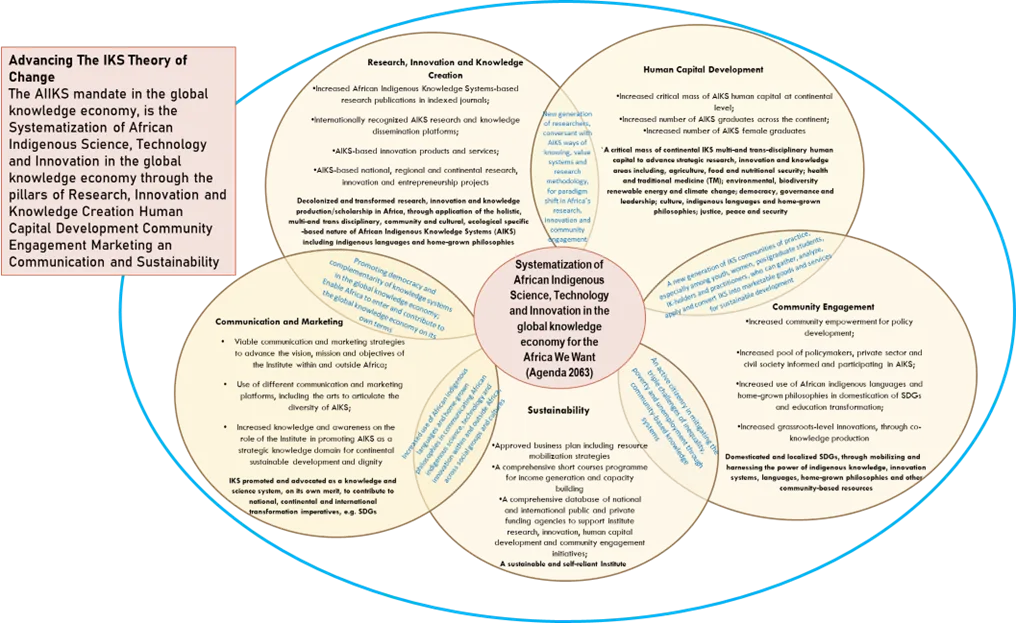
Our Theory of Change

AIIKS Theory of Change

The Evolution of AIIKS to UNESCO C2C:

Transformation Woven Through Time

The Evolution of AIIKS to UNESCO C2C

A Timeline of Transformation

The trajectory of the African Institute in Indigenous Knowledge Systems (AIIKS) is more than an academic timeline; it is a movement toward the cognitive justice of the African continent. From its humble beginnings as a pioneering degree to its status as a UNESCO Category 2 Centre, the journey reflects a systemic shift in how indigenous knowledge systems are governed, taught, and protected.

The Legacy of the Journey

Restoring the African Voice in the Global Knowledge Economy

The history of AIIKS is not just a record of administrative growth; it is the story of restoring the African voice in the global knowledge economy. By moving from a single university project to a UNESCO-mandated centre, AIIKS has ensured that African Indigenous Knowledge Systems is no longer viewed as "alternative" — but as a primary source of innovation for a sustainable future.

Global Call to Action

Shaping the Future through the AIIKS UNESCO C2C Network

The African Institute in Indigenous Knowledge Systems (AIIKS), a UNESCO Category 2 Centre, extends a strategic invitation to global youth, researchers, and development partners. We are bridging the gap between ancient African wisdom and frontier digital technologies to redefine innovation through a "bicultural" approach.

The Core Mission: A Bicultural Revolution

AIIKS believes the solutions to global climate, health, and social crises lie at the intersection of Indigenous Knowledge Systems (IKS) and high-tech tools like AI, Blockchain, and Big Data.

Strategic Pillar 1

Frontier Research & Digital Integration

We invite tech-innovators and transdisciplinary teams to validate and digitize indigenous science:

Climate & DRR: Scaling drought-resistant techniques via digital modelling.

ATM Value Chains: Utilizing Blockchain for transparent sourcing of African Traditional Medicine.

Data Sovereignty: Developing ethical AI to protect community intellectual property.

Ancestral Science: Exploring the biomechanics of traditional textiles and sustainable architecture.

Strategic Pillar 2

Human Capital & Skill Capacity Building

We are cultivating a new generation of leaders who are fluent in both coding and oral traditions:

Youth Internships: Hands-on experience in decolonizing curricula.

Green Entrepreneurship: Transforming traditional crafts and foods into scalable "green" enterprises.

Digital Literacy: Bringing high-tech skills directly to local knowledge holders.

Strategic Pillar 3

Community Engagement for Inclusive Futures

Ensuring innovation serves people, not just markets:

Participatory Action Research (PAR): Elders and practitioners as co-researchers.

Inclusive Tech: Developing sign language tools and digital accessibility for vulnerable groups.

Cultural Revitalization: Using digital supply chains to protect "lost" crops and traditional music.

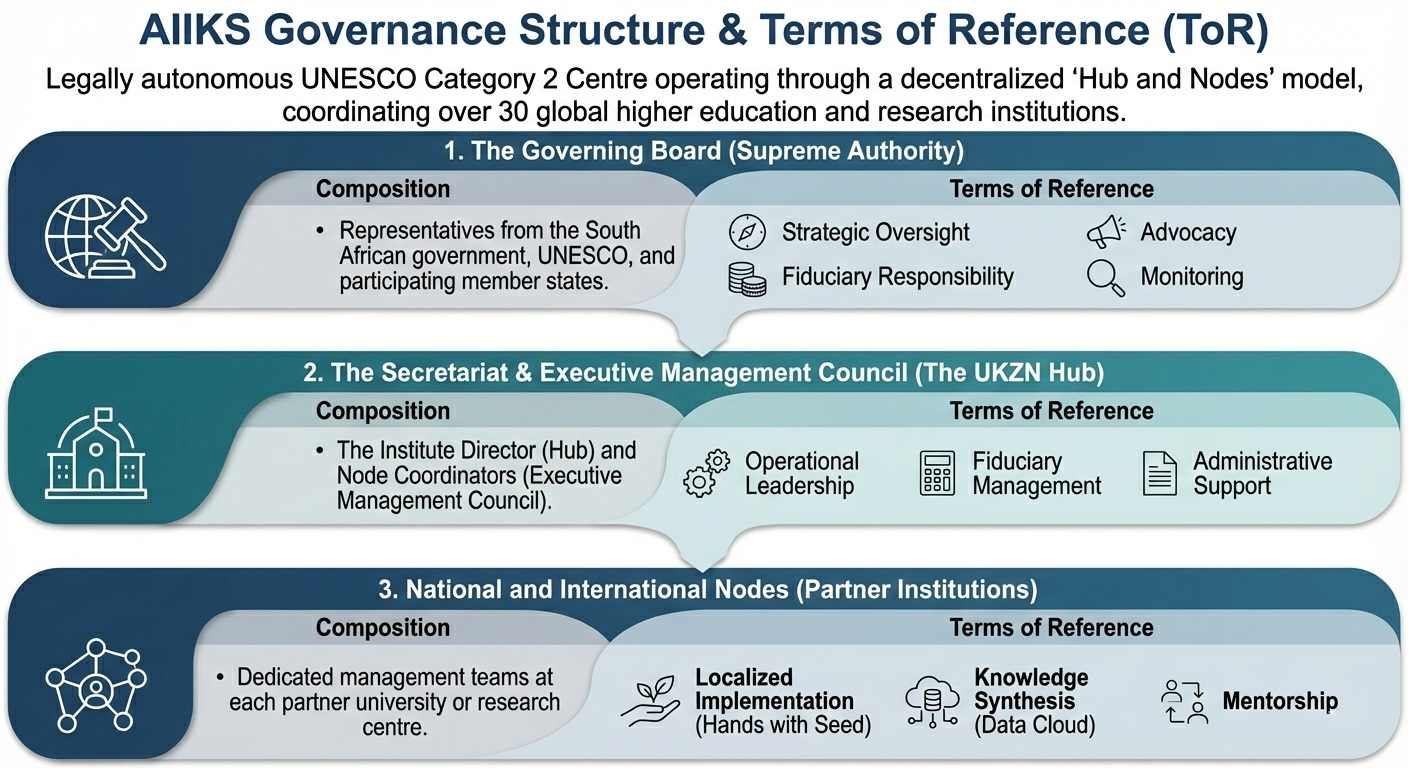
The Governance Structure and Terms of Reference (ToR)

AIIKS operates as a legally autonomous UNESCO Category 2 Centre through a decentralized "Hub and Nodes" model, coordinating over 30 global higher education and autonomous research institutions. Its governance ensures strategic alignment with international agendas while maintaining operational flexibility.

Level 1

1. The Governing Board (Supreme Authority)

Composition:

Representatives from the South African government, UNESCO, and participating member states.

Terms of Reference:

  • Strategic Oversight: Approves multi-year plans aligned with UNESCO, AU Agenda 2063, and UN SDGs.
  • Fiduciary Responsibility: Reviews budgets and financial statements to ensure transparency for international donors.
  • Advocacy: Acts as global ambassadors to secure funding and political support.
  • Monitoring: Oversees high-level evaluation of the Institute’s impact.
Level 2

2. The Secretariat & Executive Management Council (The UKZN Hub)

Composition:

The Institute Director (Hub) and Node Coordinators (Executive Management Council).

Terms of Reference:

  • Operational Leadership: Bridges high-level policy with grassroots execution.
  • Fiduciary Management: UKZN serves as the agent managing separate accounts and audits.
  • Administrative Support: Provides central communication, legal contracting, and project management.
Level 3

3. National and International Nodes (Partner Institutions)

Composition:

Dedicated management teams at each partner university or research centre.

Terms of Reference:

  • Localized Implementation: Executes community-centred programs and "Signature Projects" (e.g., Traditional Medicine).
  • Knowledge Synthesis: Funnels grassroots research back to the Hub to maintain a unified "Living Laboratory."
  • Mentorship: Facilitates intergenerational dialogues and mentorship within their specific regions.

Swipe to explore the Governance Structure

AIIKS Theory of Change