MUĞLA, TURKEY – As the world rapidly navigates the expansion of Artificial Intelligence (AI), digital transformation, and emerging technologies, the African Institute in Indigenous Knowledge Systems (AIIKS), a UNESCO Category 2 Centre (C2C) with its hub at the DSTI-NRF Centre of Excellence in Indigenous Knowledge Systems (CEIKS) hosted at the University of KwaZulu-Natal (UKZN), continues to position Africa at the forefront of global conversations surrounding ethical innovation, digitalization, and societal transformation.
Through its growing international collaborations, including partnerships with institutions such as the United Nations University – Institute for Environment and Human Security (UNU-EHS), AIIKS is demonstrating how Indigenous Knowledge Systems (IKS) can contribute meaningfully to the development of inclusive, ethical, and culturally grounded technological futures.
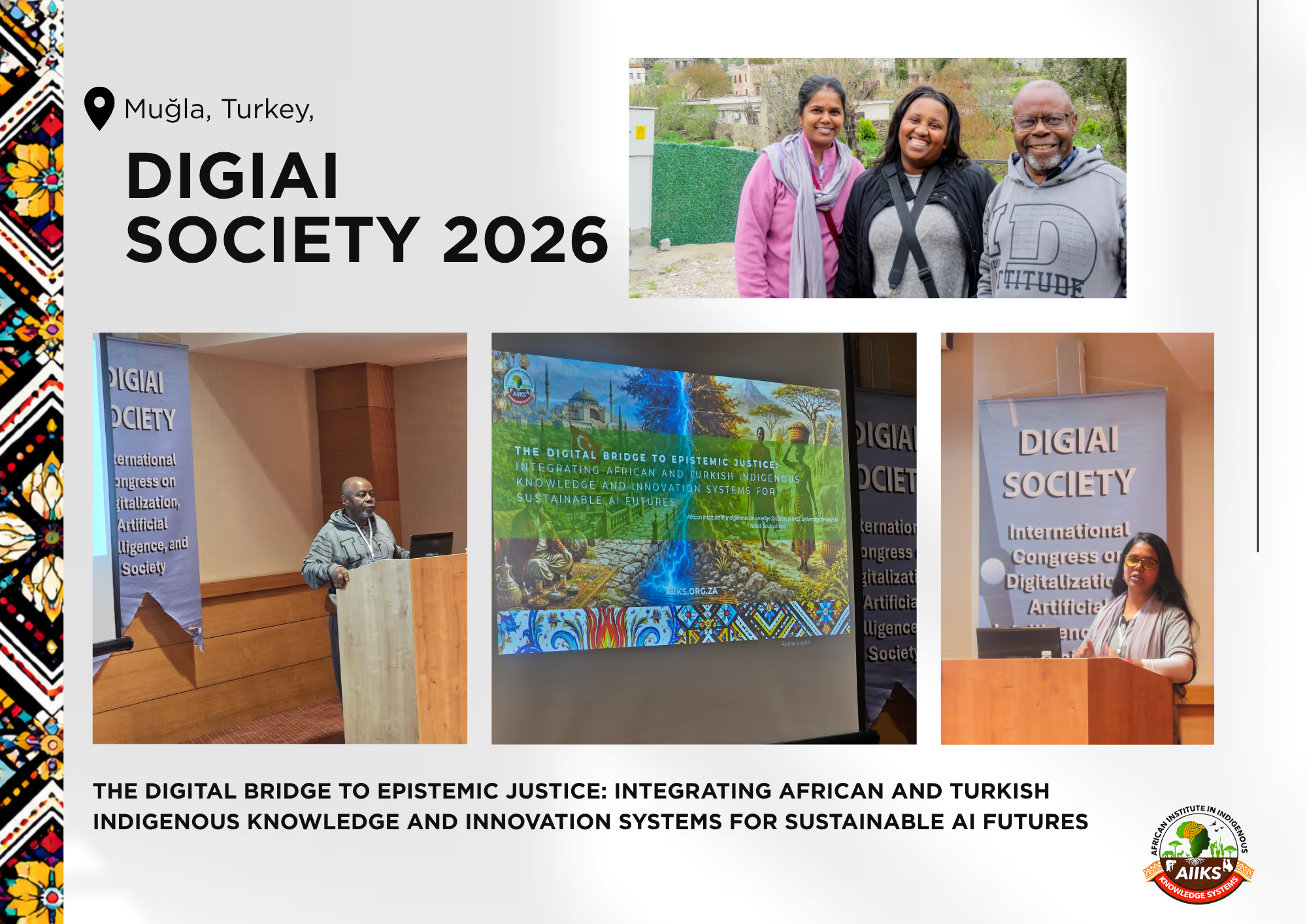
This global leadership was prominently reflected through the participation of an AIIKS delegation at the prestigious 2nd International Congress on Digitalization, Artificial Intelligence, and Society (DIGIAI Society 2026), held from 5–8 April 2026 in Muğla, Turkey.
Positioning Africa Within Global AI Conversations
DIGIAI Society 2026 served as an important international platform bringing together scholars, researchers, innovators, policymakers, and institutions from across the globe to examine the relationship between artificial intelligence, digitalization, and society. As AI continues to reshape economies, governance systems, education, healthcare, and social structures worldwide, critical questions are emerging regarding ethics, inclusion, cultural representation, and the societal impact of technology.
For AIIKS and CEIKS, participation in the congress represented more than academic engagement; it was a strategic intervention to ensure that African Indigenous Knowledge Systems, indigenous sciences, and African philosophies are not excluded from the rapidly evolving global AI landscape.
The delegation’s participation, spanning a high-level plenary session, an international workshop, and a dedicated exhibition, was anchored by the theme:
“Beyond the Frontier: Driving Global Resilience through Youth-Led Digital and Indigenous Innovations.”
Through this engagement, AIIKS challenged the false assumption that indigenous knowledge systems and digital technologies exist in opposition to one another. Instead, the Institute demonstrated how Indigenous Knowledge Systems and frontier technologies can be meaningfully integrated to address contemporary global challenges including climate change, ethical AI development, sustainability, disaster risk reduction, and social inequality.
Leveraging Indigenous Knowledge and African Philosophies
A major focus of the Centre’s contribution at DIGIAI Society 2026 was the integration of frontier technologies with African indigenous languages, Indigenous Knowledge Systems, and home-grown philosophies. This reflects a growing international recognition that sustainable technological development must incorporate diverse cultural perspectives and local knowledge traditions.
African indigenous philosophies often emphasize relationality, ethical responsibility, collective well-being, environmental stewardship, and community-centred governance. These principles offer valuable insights into how AI systems can be developed responsibly and inclusively, prioritizing humanity and social justice rather than purely economic or technological interests.
By introducing indigenous languages and African epistemologies into discussions on digital transformation, AIIKS and CEIKS are helping to challenge one-dimensional technological models that frequently overlook cultural context and local realities. This work also contributes toward preserving linguistic and cultural diversity within digital environments, ensuring that African communities are not excluded from future technological developments due to language or cultural barriers.
The Institute further highlighted the importance of cognitive justice — the recognition and validation of multiple knowledge systems within global research and policy spaces. Through its participation, AIIKS advocated for inclusive innovation models that move beyond narrow Eurocentric frameworks and embrace culturally grounded approaches to technological advancement.
Youth as Digital Stewards
One of the defining themes of the AIIKS presentation in Turkey was the empowerment of youth-led innovation. Recognizing that young scholars across Africa and the Global South are uniquely positioned to navigate both indigenous and digital knowledge systems, the delegation showcased how youth are reimagining Indigenous Knowledge Systems through emerging digital tools and technologies.
Examples discussed included the use of Geographic Information Systems (GIS) to map traditional ecological boundaries, digital archiving initiatives for indigenous languages, and the use of blockchain technologies to protect community intellectual property and indigenous data sovereignty.
Through these initiatives, AIIKS is championing a model where young people are not merely consumers of technology, but active Digital Stewards of their cultural heritage and innovation systems. This approach aims to strengthen collaborative frameworks that enable African youth, researchers, and innovators to contribute meaningfully to global knowledge production and technological governance.
Students and researchers participating in the congress also demonstrated how Indigenous Knowledge Systems can contribute to addressing pressing global challenges related to sustainability, governance, climate adaptation, and the “Just Transition.”
The concept of the “Just Transition” emphasizes the importance of ensuring that environmental and technological transitions occur in ways that are fair, inclusive, and socially equitable. AIIKS highlighted that Indigenous Knowledge Systems can provide valuable guidance for ethical decision-making, participatory governance, and community resilience during periods of rapid technological change.
Bridging Knowledge Systems Through Global Partnerships
Participation in DIGIAI Society 2026 also represented an important opportunity to strengthen international academic and research networks. By engaging with scholars and institutions in Muğla, AIIKS continued its work of building bridges between traditional knowledge practitioners and emerging technology specialists.
These international partnerships are central to advancing:
• Cognitive Justice through elevating African Indigenous Knowledge Systems within global research and policy discussions;
• Inclusive Innovation by ensuring AI systems are developed using culturally diverse and representative datasets;
• Reciprocity and Collaboration through mutually beneficial exchanges between local indigenous communities and international academic institutions.
The Institute’s expanding global collaborations demonstrate a commitment to ensuring that Indigenous Knowledge Systems are not treated as historical artefacts, but as living, dynamic systems capable of contributing to contemporary scientific, technological, and societal challenges.
Building Ethical and Inclusive AI Futures
As digital transformation increasingly shapes governance, healthcare, education, economic participation, and everyday life, there is a growing need to ensure that technological systems reflect the realities, values, and lived experiences of diverse societies.
The work of AIIKS and CEIKS demonstrates that the future of AI and digitalization must be rooted in inclusivity, ethical responsibility, cultural diversity, and human-centred innovation. Their participation at international platforms such as DIGIAI Society 2026 reinforces the importance of integrating Indigenous Knowledge Systems into global innovation ecosystems.
By bridging Indigenous Knowledge Systems with frontier technologies, the Institute is helping to ensure that future AI systems respect cultural values, support social justice, protect indigenous intellectual heritage, and contribute toward more equitable and sustainable global futures.
Conclusion
The African Institute in Indigenous Knowledge Systems and the DSTI-NRF Centre of Excellence in Indigenous Knowledge Systems are emerging as influential global voices at the intersection of Indigenous Knowledge Systems, artificial intelligence, and digital transformation.
Their participation at DIGIAI Society 2026 highlighted the growing relevance of African indigenous philosophies, languages, and cultural knowledge in shaping ethical and inclusive technological futures. Through research, partnerships, youth empowerment, and international collaboration, AIIKS continues to advocate for a model of technological advancement that values humanity, cultural diversity, and collective well-being.
As the global AI landscape continues to evolve, AIIKS remains committed to ensuring that Africa’s rich knowledge traditions are not only preserved, but actively integrated into the future of digital innovation and global resilience.
Jadon Patrick Napier
Research Associate
African Institute in Indigenous Knowledge Systems (AIIKS)
University of KwaZulu-Natal, South Africa
Through its growing international collaborations, including partnerships with institutions such as the United Nations University – Institute for Environment and Human Security (UNU-EHS), AIIKS is demonstrating how Indigenous Knowledge Systems (IKS) can contribute meaningfully to the development of inclusive, ethical, and culturally grounded technological futures.
This global leadership was prominently reflected through the participation of an AIIKS delegation at the prestigious 2nd International Congress on Digitalization, Artificial Intelligence, and Society (DIGIAI Society 2026), held from 5–8 April 2026 in Muğla, Turkey.
Positioning Africa Within Global AI Conversations
DIGIAI Society 2026 served as an important international platform bringing together scholars, researchers, innovators, policymakers, and institutions from across the globe to examine the relationship between artificial intelligence, digitalization, and society. As AI continues to reshape economies, governance systems, education, healthcare, and social structures worldwide, critical questions are emerging regarding ethics, inclusion, cultural representation, and the societal impact of technology.
For AIIKS and CEIKS, participation in the congress represented more than academic engagement; it was a strategic intervention to ensure that African Indigenous Knowledge Systems, indigenous sciences, and African philosophies are not excluded from the rapidly evolving global AI landscape.
The delegation’s participation, spanning a high-level plenary session, an international workshop, and a dedicated exhibition, was anchored by the theme:
“Beyond the Frontier: Driving Global Resilience through Youth-Led Digital and Indigenous Innovations.”
Through this engagement, AIIKS challenged the false assumption that indigenous knowledge systems and digital technologies exist in opposition to one another. Instead, the Institute demonstrated how Indigenous Knowledge Systems and frontier technologies can be meaningfully integrated to address contemporary global challenges including climate change, ethical AI development, sustainability, disaster risk reduction, and social inequality.
Leveraging Indigenous Knowledge and African Philosophies
A major focus of the Centre’s contribution at DIGIAI Society 2026 was the integration of frontier technologies with African indigenous languages, Indigenous Knowledge Systems, and home-grown philosophies. This reflects a growing international recognition that sustainable technological development must incorporate diverse cultural perspectives and local knowledge traditions.
African indigenous philosophies often emphasize relationality, ethical responsibility, collective well-being, environmental stewardship, and community-centred governance. These principles offer valuable insights into how AI systems can be developed responsibly and inclusively, prioritizing humanity and social justice rather than purely economic or technological interests.
By introducing indigenous languages and African epistemologies into discussions on digital transformation, AIIKS and CEIKS are helping to challenge one-dimensional technological models that frequently overlook cultural context and local realities. This work also contributes toward preserving linguistic and cultural diversity within digital environments, ensuring that African communities are not excluded from future technological developments due to language or cultural barriers.
The Institute further highlighted the importance of cognitive justice — the recognition and validation of multiple knowledge systems within global research and policy spaces. Through its participation, AIIKS advocated for inclusive innovation models that move beyond narrow Eurocentric frameworks and embrace culturally grounded approaches to technological advancement.
Youth as Digital Stewards
One of the defining themes of the AIIKS presentation in Turkey was the empowerment of youth-led innovation. Recognizing that young scholars across Africa and the Global South are uniquely positioned to navigate both indigenous and digital knowledge systems, the delegation showcased how youth are reimagining Indigenous Knowledge Systems through emerging digital tools and technologies.
Examples discussed included the use of Geographic Information Systems (GIS) to map traditional ecological boundaries, digital archiving initiatives for indigenous languages, and the use of blockchain technologies to protect community intellectual property and indigenous data sovereignty.
Through these initiatives, AIIKS is championing a model where young people are not merely consumers of technology, but active Digital Stewards of their cultural heritage and innovation systems. This approach aims to strengthen collaborative frameworks that enable African youth, researchers, and innovators to contribute meaningfully to global knowledge production and technological governance.
Students and researchers participating in the congress also demonstrated how Indigenous Knowledge Systems can contribute to addressing pressing global challenges related to sustainability, governance, climate adaptation, and the “Just Transition.”
The concept of the “Just Transition” emphasizes the importance of ensuring that environmental and technological transitions occur in ways that are fair, inclusive, and socially equitable. AIIKS highlighted that Indigenous Knowledge Systems can provide valuable guidance for ethical decision-making, participatory governance, and community resilience during periods of rapid technological change.
Bridging Knowledge Systems Through Global Partnerships
Participation in DIGIAI Society 2026 also represented an important opportunity to strengthen international academic and research networks. By engaging with scholars and institutions in Muğla, AIIKS continued its work of building bridges between traditional knowledge practitioners and emerging technology specialists.
These international partnerships are central to advancing:
• Cognitive Justice through elevating African Indigenous Knowledge Systems within global research and policy discussions;
• Inclusive Innovation by ensuring AI systems are developed using culturally diverse and representative datasets;
• Reciprocity and Collaboration through mutually beneficial exchanges between local indigenous communities and international academic institutions.
The Institute’s expanding global collaborations demonstrate a commitment to ensuring that Indigenous Knowledge Systems are not treated as historical artefacts, but as living, dynamic systems capable of contributing to contemporary scientific, technological, and societal challenges.
Building Ethical and Inclusive AI Futures
As digital transformation increasingly shapes governance, healthcare, education, economic participation, and everyday life, there is a growing need to ensure that technological systems reflect the realities, values, and lived experiences of diverse societies.
The work of AIIKS and CEIKS demonstrates that the future of AI and digitalization must be rooted in inclusivity, ethical responsibility, cultural diversity, and human-centred innovation. Their participation at international platforms such as DIGIAI Society 2026 reinforces the importance of integrating Indigenous Knowledge Systems into global innovation ecosystems.
By bridging Indigenous Knowledge Systems with frontier technologies, the Institute is helping to ensure that future AI systems respect cultural values, support social justice, protect indigenous intellectual heritage, and contribute toward more equitable and sustainable global futures.
Conclusion
The African Institute in Indigenous Knowledge Systems and the DSTI-NRF Centre of Excellence in Indigenous Knowledge Systems are emerging as influential global voices at the intersection of Indigenous Knowledge Systems, artificial intelligence, and digital transformation.
Their participation at DIGIAI Society 2026 highlighted the growing relevance of African indigenous philosophies, languages, and cultural knowledge in shaping ethical and inclusive technological futures. Through research, partnerships, youth empowerment, and international collaboration, AIIKS continues to advocate for a model of technological advancement that values humanity, cultural diversity, and collective well-being.
As the global AI landscape continues to evolve, AIIKS remains committed to ensuring that Africa’s rich knowledge traditions are not only preserved, but actively integrated into the future of digital innovation and global resilience.
Jadon Patrick Napier
Research Associate
African Institute in Indigenous Knowledge Systems (AIIKS)
University of KwaZulu-Natal, South Africa
Stay Connected
AIIKS Global Hub
Transforming Knowledge Systems